IAM15 Guest Post…Author talk-show ‘Changes’

IAM 2015 - TopperToday we’re pleased to welcome author Sally Ember to Indie Author Month.

The experiences of every author are different – how they come to write in the first place…how their writing evolves over time…how their life experiences shape their work…

Sally’s guest post is one of the most interesting and in-depth we’ve had for an author feature on the blog. We hope you enjoy reading it and learning more about her work, just as we did.

——————————————————-

Sally Ember - Author  “Why I Started a LIVE Talk Show: *CHANGES* conversations between authors on Google+ Hangouts On Air (HOA) and YouTube”

 In early April, 2014, I had just completed and uploaded Volume II, This Changes My Family and My Life Forever, of my science-fiction/romance/ multiverse/ utopian/ paranormal (psi) ebooks in The Spanners Series for adults, New and Young Adults, and joined two new writers’ groups in the East Bay (one in Berkeley and one in Hayward, California, where I had been living), when I was in a terrible accident. The resulting broken nose has been healing fine and didn’t require surgery; the concussion has proven to be a lot more problematic.

For several months, it was as if I were in a fog. I wasn’t allowed to do any serious computer work, reading or thinking (I had been about halfway through Volume III, This Is/Is Not the Way I Want Things to Change, when I got hurt). Since I couldn’t wear my glasses without causing myself enormous pain (glasses would be sitting on the broken nose, right?), and I was overwhelmingly aphasic, exhausted, confused and injured, unable to process much, the respite from writing, reading and working seemed necessary. The accident had also caused extreme damage to my arms, hands, shoulders and upper back, so keyboarding wasn’t all that feasible, anyway. Plus, when I did type, I made more errors than words, typed very slowly (usually over 100 WPM; then, about 40 WPM, with numerous mistakes).

However, once the enforced hiatus was over, I still couldn’t return to my regular life. My memory was horrible, both short- and long-term. I couldn’t find words, or the right words, to speak or write. I no longer sounded as if I were drunk, but I was still extremely slower and less able, all around, than I had been prior to the brain injury. I usually function in the top 10 percent of intellectuals, with an extremely large vocabulary and many types of intelligence. I had been fortunate, up until the accident, to be a wide reader of many subjects, with both formal and informal education beyond the doctoral level and a larger variety of knowledge, experiences and insights than most people. Post-concussion, I was barely above-average and often, not even that.

 Before the injury to my brain, I had been writing my fiction series quite quickly, often exceeding 2,000 words per day. My creativity seemed boundless, my energy matching it. Volume I’s first draft had been completed in under two months, and it was over 130,000 words. I had developed a spreadsheet to record my (very brief) notes on my series’ dozens of human, animal and alien characters, multiple timelines, overlapping realities, historical and future events and people, but most of the series’ details and plans had been in my brain which had been injured to the point of being severely compromised.

 In July of last year, I discovered all I could create were short, nonfiction blog and other posts, and it took “forever” to finalize each one, since I typed sentences that were riddled with errors. Each post needed to be proofread multiple times. I could barely read others’ blogs and reblog/share, almost couldn’t read short pieces/stories.

 Yes, after a few months I was improving and could do these with increasingly better understanding, but I still couldn’t return to my fiction series. My “executive functions” and “working memory” were still extremely low-performing due to the post-concussion syndrome I had been diagnosed with in June.

 I wasn’t well enough to return to my “regular” life of work or writing, but I was well enough to be bored. Luckily, I had discovered Google+ the previous year. During the winter and spring of 2014, I had been attending Hangouts On Air (HOAs) somewhat regularly. I attended and participated (when that was allowed) in many HOAs by leaving comments, questions, and interactions with others also viewing or presenting, on topics ranging from books, book marketing, authors, writing, marketing, social media, spirituality/meditation and more. I watched most on Google+, but they were also archived so I could watch those I missed on YouTube, where I found even more entertaining, informative videos.

After my accident, watching videos was about the only thing I could do, since reading, writing and other glass-wearing activities were excluded. I got into watching one HOA in particular, “Lights, Camera, HOA!”, run by an excellent trio of women: Meloney Hall, Rayne Dowell and Sheila Strover.

 After I attended a few shows, Rayne read Volume I of my series and reached out to invite me onto the show to learn more about being in/on a HOA. The entire reason for this show’s existence is to help newbies (like me) get comfortable with the HOA format and technology, both on- and off-camera. I LOVED it! What a great service this show provides. THANK YOU! https://plus.google.com/u/0/+Bigupticksociallightscamerahoa/about

 As a former actor/performer, being “on camera” wasn’t hard for me. As a writer/author, being able to interact with viewers LIVE was so much better than having readers I almost never hear from or meet. I was hooked on HOAs and wanted my own. I learned everything I could in the next several months, wondering if I’d be able to manage my own show.

 What could I have a HOA about, exactly? There were an infinite number of choices. By then, I had been interviewed on several radio shows online and submitted many “author interview” posts to others’ websites, so I was familiar with that format and was beginning to feel it was somewhat overused. Frankly, and no offence to the current website(!), I find most author interviews to be awfully repetitive and, well, boring.

 I did NOT want to interview authors, but I wanted to meet more authors and talk about writing as well as many other interesting topics. By the end of July, four months post-injury, I still couldn’t write for my series, but I was able to talk better and listen very well. I decided to launch in August and to have a show that I would want to watch.

 Since I wanted to be around other writers and hear about their experiences, hoping to be entertained and inspired until my own writing would (hopefully) be accessible to me again, I posted on Twitter, Facebook groups and in general, Pinterest, LinkedIn, and Google+ communities to invite authors to be guests on *CHANGES* conversations between authors. I also ranged around to those sites that posted award winners in science-fiction, particularly, and invited many of those authors on my show as well.

 The response has been more than gratifying. I welcomed Dr. Shay West as my first guest for my August 6, 2014, premier Episode, with several more super authors scheduled to be on subsequent shows. Since then, with a few planned and even fewer unplanned exceptions, I have had an Episode each week. The live show airs three or four times per month (with one week off, to rest) on Wednesdays, 10 – 11 AM Eastern time, and in August 5, 2015, I will air my one-year anniversary show!

 Amazing authors have been guests on *CHANGES* (http://goo.gl/1dbkZV on my website for full schedule of past and upcoming guests). I have had guests who joined me live from France, Spain, England, Scotland, Ireland, Germany, Canada, and many states in the USA. The authors I have talked with enrich me weekly (and my viewers as well, I hope), writing in every fiction genre and including those who also write nonfiction, plays, screenplays and poetry. Ethnically, my guests have been American mixed-Causasian, African-American, African-Jamaican, Spanish, English, Indian (continent, not tribe), Russian, Jewish, German, Norwegian, and Greek (so far). Editors, publishers (magazine and book), and translators, with an age range, as of August 5, 2015, of 16 – 78 years old, are in my *CHANGES* guests club.

Our conversational topics list is too lengthy to include here, but has been exactly as I had planned: wide variety, high-level subject discussions that are informative, entertaining, insightful, funny and poignant. My guests and I share personal and professional stories, discuss books and writing, publishing and editing, book cover artists and much more.

I am quite happy to say that, as of June, 2015, *CHANGES* Episodes (now up to 32, http://goo.gl/1dbkZV on YouTube) have garnered audiences as large as over 1000 in one day, totalling over 2300 views, so far. My YouTube channel went from having 2 to over 40 subscribers. I now have over 2400 followers on Google+ and Facebook, each (although some are the same people, I’m sure), and almost 5000 on Twitter. Pinterest followers’ number has quadrupled; so has LinkedIn’s. Many compliments, positive comments and excellent questions appear for each *CHANGES* Episode from viewers who watch live or later.

I wish to convert the *CHANGES* videocasts into podcasts, for those who prefer to listen-only, but the podcast hosting sites are not free. I also wish to pay for my next book covers, buy better equipment for my home videocasts, and keep writing, but the concussion has severely limited my ability to work and I am in deep debt. If you’d like to help, http://www.patreon.com/sallyember has a video about my goals and rewards to donors in which I sing (really; not so well, but, hey; I’m not a professional singer!), and more information. $4 gets you a free ebook; larger donations earn you deep discounts on professional editing, proofreading and writing tutor services, all of which can do well, despite the concussion.

Since starting *CHANGES*, I’m delighted to report that downloads of Volume I of my series, which is permafree since I uploaded Volume II (right before my accident), are steady. I do wish for better sales for Volume II, but I’ve heard a series has to have three books released to “really take off.”

About that: in other good news, as of May, 2015, I am back to writing new parts of Volume III! I hope to finish all drafts and revisions (more slowly, but well) by mid-fall, to release it around November or December, if all goes well. Wish me luck!

Beta readers and reviewers of all Volumes welcomed! Contact me: sallyember AT yahoo DOT com

CHANGES Trailer Image_3

Also, watch a few Episodes of *CHANGES*any time: http://goo.gl/6xjSKl

#Authors and #bloggers, especially those in sci-fi/speculative fiction, but not only those: learn more about and get yourself on *CHANGES*, and #Readers, recommend an #author to be scheduled as a guest. More info, schedule and past/upcoming guests list here: http://goo.gl/1dbkZV.

I strongly suggest you check out others’ HOAs as well: there are some great shows out there in Google+ land! Two good places to find them (and another great G+ community, User2User: LIVE!):

https://plus.google.com/u/0/communities/101944073205735325459 for User2User-Live!

Http://www.hangouteventscalendar.com


Best to you all!

———————————-
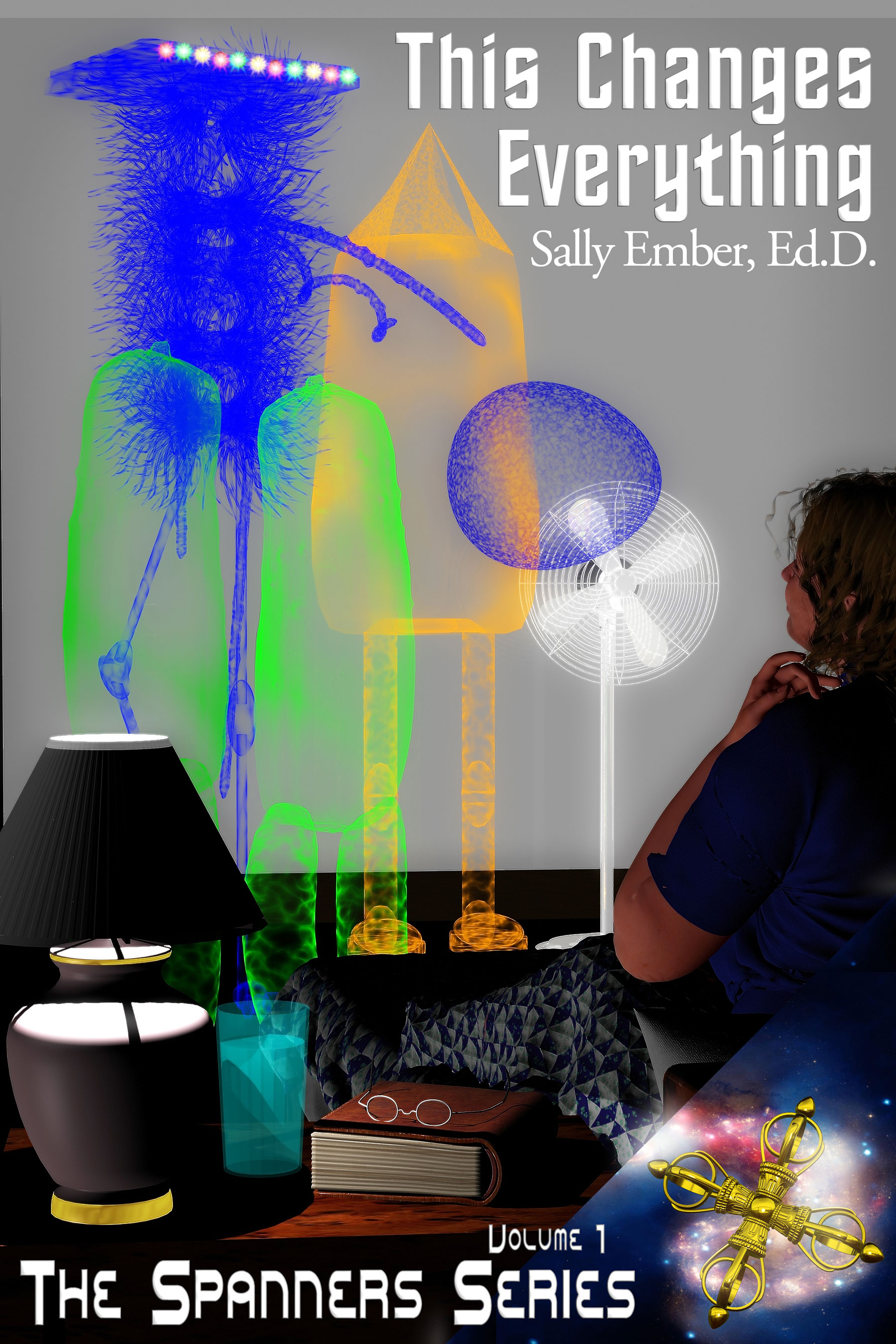
This-Changes-Everything----web-and-ebooks  Volume I, This Changes Everything

  The Spanners Series

Dr. Clara Ackerman Branon, 58, begins having secret visits from holographic representations of  beings from the Many Worlds Collective, a consortium of planet and star systems in the multiverse.  When Earth is invited to join the consortium, the secret visits are made public. Now Earthers must adjust their beliefs and ideas about life, religion, culture, identity and everything they think and are. Clara is selected to be the liaison between Earth and the Many Worlds Collective and she chooses Esperanza Enlaces to be the Media Contact. They team up to provide information to stave off riots and uncertainty. The Many Worlds Collective holos train Clara and the Psi-Warriors for the Psi Wars with the rebelling Psi-Defiers, communicate effectively with many species on Earth and off-planet, eliminate ordinary, elected governments and political boundaries, convene a new group of Global Leaders, and deal with family’s and friends’ reactions. In what multiple timelines of the ever-expanding multiverse do Clara and her long-time love, Epifanio Dang, get to be together and which leave Clara alone and lonely as the leader of Earth? This Changes Everything begins the 30-year story of Clara’s term as Earth’s first Chief Communicator, continuing in nine more Volumes of The Spanners Series. Are YOU ready for the changes?

———————————–

Want to know more? Check out the links!

Sally Ember, Ed.D., has been passionate about writing since she was nine years old, winning prizes for her poetry, stories, songs and plays from a young age. She also began meditation in her teens. Now, Sally delights fans of psi elements with romance by blurring the lines between fact and fiction in The Spanners Series ebooks, a multiverse of multiple timelines, often including exciting elements of utopian science-fiction and Buddhism, for New Adult/adult/YA audiences; two out (first is permafree) with eight to come, Born Jewish on the cusp of Leo and Virgo, Sally’s life has been infused with change. Currently, she meditates, writes, swims, reads and hosts her Google+ Hangout On Air (HOA) *CHANGES* conversations between authors, LIVE conversations with authors, almost every Wednesday, 10 – 11 AM Eastern time, USA.


BOOK LINKS:

Volume I, Permafree:

https://www.smashwords.com/books/view/376197

Volume II, $3.99:

https://www.smashwords.com/books/view/424969
OTHER LINKS:

http://www.sallyember.com
http://www.amazon.com/-/e/B00HEV2UEW  Author Central Amazon page

https://www.twitter.com/sallyemberedd   Twitter: @sallyemberedd

https://www.facebook.com/TheSpannersSeriesbySallyEmber   Spanners Series‘ page on FB

https://www.facebook.com/sally.ember

http://www.pinterest.com/sallyember

http://goo.gl/tZKQpv   Spanners Series‘ page on Google+

http://www.google.com/+SallySueEmber   Sally Sue Ember on Google+

https://www.youtube.com/channel/UCqnZuobf0YTCiP6silDDL2w/videos

https://www.goodreads.com/author/show/7237845.Sally_Ember

CROWDFUNDING SITE: http://www.patreon.com/sallyember

IAM15 Guest Post…Writing Problem Characters

IAM 2015 - TopperAnyone who has been around Aside from Writing before may well recognise today’s guest author – Hazel West – from her visits to the blog in previous Indie Author Month events, or from our review of her novel On a Foreign Field (you can link to Hazel’s other features on the blog here).

So, we’re very happy to welcome back our regular visitor and see what she has to share about writing ‘problem’ characters. A little bit of Writing 101 for you today, along with meeting a lovely author.

Plus, as it’s the fourth of July, we thought it only proper that an American author take the centre stage today 🙂

—————————————-

Writing Problem Characters

If you have not encountered a character who has given you problems at least once, then chances are you aren’t actually a writer. Something I always tell writers who are starting out is that characters are people too. This helps to form realistic characters but it also means they can take on a life of their own, and usually to the chagrin of the writer. These problems can either manifest as characters being unwilling to cooperate with you, refusing to do what you want them to, or even becoming completely different characters all together. I’ve had villains decide they were more anti-heroes by the time I get to the end of a first draft and have to go back and rewrite everything to accommodate their newfound generosity. It can definitely be troubling, but here are some tips to make dealing with problem characters easier.

First off, another thing I tell new writers is to just listen to your characters, because, yes, they do talk to you; no, you aren’t going crazy even though you hear those voices in your head when you’re trying to sleep at night. Usually if you just listen to your characters and let them run the story, even if it’s not anything like how you imagined it starting out, things should go smoothly. You can’t write characters out of character and expect your process to go well.

Sometimes it’s a little more complicated than that. If your character has decided they are not going to be the person you thought they were, they you may have quite a bit of decision making to do and things to figure out. In this case, you may—and likely will—have to change parts of the story itself to fit their new personality. If you haven’t realized it yet, characters are divas, and you do have to cater to them if you want your story to go well. Otherwise, they have a way of sabotaging stories if they don’t get their way. If your baddie decides to go good, you might have to create another villain to keep the story going, otherwise your readers will feel cheated and all thanks to your ex-baddie’s change of heart. Villains seem to be some of the most problematic characters to write. If they’re not leaving the dark side, they refuse to tell you their plans and why they are doing what they’re doing, which makes fun many long frustrating hours of trying to squeeze information from them all while attempting to construct a plot without any real reason behind it. Infuriating. Unfortunately, this is just one of those things that has to be worked out in time. There are really no good ways to get your villain to talk, although you can always try torture if you wish.

I have also found names to be a huge factor in character personalities. If it turns out a name really doesn’t fit the character, you may have a very hard time writing them and getting their voice correct. I usually play with names and spellings a long time before I start writing a book. I know there were certain times where I have had a hard time writing a character but after changing their name, it was super easy. Just another one of those weird tips that writers pick up.

Everyone has problem characters, it’s impossible not to, but don’t let it stop your writing process! I hope these tips might help a bit, or you might find other things that will help you more. Let me know some of your tips for wrangling those characters who just don’t want to cooperate.

———————————–

bloodtiescover copy In an Ireland that mixes high kings, faeries, and modern warriors who drive fast cars, Ciran, a descendant from the famous warrior Fionn Mac Cool, bands together with a company of young warriors to go on a quest to recover their missing family members who were captured on patrol by the Goblins during a shaky peace between the two kingdoms. Ciran and his companions must figure out not only how they are going to rescue the prisoners, but how they are going to complete their mission without killing each other. This first book in the new urban fantasy series by Hazel West is a story of brotherhood and friendship against all odds, that mixes the ancient Irish legends with a modern setting for an action-packed read.

(Coming Fall 2015)

Want to know more? Check out the links!

Hazel West lives in Florida and took up writing mostly as an excuse to stay out of the heat. Apart from being an Indie author, she also enjoys reading, drawing, drinking coffee, and knitting and crochet. Hazel is also a lover of all this historical and a good deal of folklore and mythology and enjoys seeing how those things can be written into stories. She currently shares her living space with a hedgehog named Horatio.

Hazel B West

Hazel B West

Blog: http://hazelwest.blogspot.com

Tales From a Modern Bard (short stories/fiction): http://talesfromamodernbard.blogspot.com

Twitter: http://www.twitter.com/artfulscribbler

Pintrest: http://www.pinterest.com/artfulscribbler/

Goodreads: https://www.goodreads.com/author/show/5289626.Hazel_B_West

You can find all my books here: http://hazelwest.blogspot.com/2013/03/purchase-links.html

IAM15 Guest Post…Marie Landry

IAM 2015 - Topper Today’s guest author for the second day of Indie Month 2015 is our lovely friend Marie Landry! Over the last few years since we started the blog in 2012 Marie has featured with us many times, sharing her writing and blogging experiences as well as her books. (You can check out previous features here).

Today she joins us sharing her thoughts on how she became an Indie Author.

Marie-Landry-AuthorHow I Became an Indie Author

I’ve always known I wanted to be a writer. I’ve had a vivid imagination my whole life, and I’ve been a storyteller for as long as I can remember. Even when my path went in various different directions during and after college, I always kept writing and hoped to be published someday. I always assumed it would be traditional publishing, because that’s all there was. I was willing to query agents, have my books sit in slush piles, and persevere until my work was out there for the world to read.

Several years ago, I began writing with a partner. We started out with fan fiction (my lips are sealed about which fandom!) and short stories, and eventually wrote a novel together that we hoped to have published. Self-publishing was quite new at the time, and after a bit of research, we knew it wasn’t the path for us. It had a horrible reputation at the time – the general consensus was that only people who could never get published traditionally were self-publishing. We sent out query after query with no success, but we kept writing.

When we parted ways as writing partners, a friend encouraged me to pull out a story I’d written after college and polish it. I spent months rewriting it while researching publishing options. This was around the time Amanda Hocking was blowing up the indie scene. I read countless articles and blog posts, and realized self-publishing was a viable option. It wasn’t that I wanted to rush the process, but I liked the idea of having complete control over editing decisions, cover, distribution, etc. I also really just wanted people to read my books and I knew with self-publishing it would be a matter of months rather than the years it can take to get published by a publisher, even once your manuscript has been sold.

I published my debut novel, Blue Sky Days, in January 2012. Over the next three years, I published five more books, and I’m currently working on my next novel, which I hope to release late this summer or early autumn. I haven’t regretted my decision to self-publish for a minute. Would it be nice to have someone else do the marketing for me? Yes. Would it be nice to have an advance or have a decent budget for marketing? Heck yeah! But does that outweigh the freedom of being my own boss and being able to get my books into the hands of people who love to read? No. Is self-publishing for everyone? No. But it’s one of the best decisions I’ve ever made.

—————————


Take-Them-by-Storm-Marie-Landry  Sadie Fitzgerald has always been different, and not just because she makes her own clothes and would rather stay home watching Doctor Who than party with kids her age. When it’s time to leave Angel Island for college, Sadie is eager to put her old life behind her. Small-minded people and rumors have plagued her for years, but with the love of her adoptive family, the O’Dells, Sadie has learned to embrace who she is. Now she’s not afraid to admit the rumors about her are true: she’s gay.
For the first time in her life, Sadie feels free to be herself. She dives into college life and begins volunteering at the local LGBT center, where she discovers her small-town upbringing left holes in her education about life outside Angel Island.
The world is a bigger and more accepting place than Sadie ever imagined. She’s finally found where she belongs, but with the reappearance of someone from her past, an unexpected new friendship, and a chance at love, Sadie soon realizes she still has a lot to learn about life, friendship, and love.


Want to know more? Check out the links!

Marie has the best job in the world—one where she gets to make stuff up for a living and shamelessly eavesdrop on everyone around her. She writes happily ever afters while dreaming about the day she’ll have her own epic love story to tell. Most days you can find her writing, reading, fantasizing about traveling the world, listening to U2, watching copious amounts of TV on DVD, or having grand adventures with her nephews and niece.

For more on Marie and her books please visit http://sweetmarie-83.blogspot.ca. She also loves to chat with fellow book lovers, so feel free to tweet her @SweetMarie83 any time!


Blog: http://sweetmarie-83.blogspot.ca

Facebook: https://www.facebook.com/MarieLandryAuthor

Twitter: https://twitter.com/SweetMarie83

Amazon: http://www.amazon.com/Take-Them-Storm-Angel-Island-ebook/dp/B00PBA7KNE/ref=asap_bc?ie=UTF8

Barnes & Noble: http://www.barnesandnoble.com/w/take-them-by-storm-marie-landry/1120852304?ean=2940046432121


IAM15 Guest Post…My Writing Journey

IAM 2015 - Topper    My second post of the day as ‘guest author’ – I can’t talk about myself in the third person too much on this blog as it leads me to feeling slightly unhinged 🙂 Anyway, as a guest of myself, I thought I’d use my post this year to talk about my writing journey, like some of our other guests are doing. These are always some of my favourite posts to read because everyone has a different tale and experience to share. It has been quite a while since I last did a ‘writing journey’ post – around this time of year in 2012 to be exact – and so there was a lot for me to take in when I came to writing one this time.

(The two previous posts can be found on my author website [here] and on Ramblings of a Daydreamer blog [here], if you are interested in how my journey started).

The main difference between then and now is time (obviously!) and practice. Back in 2012, I was new to the whole promotion, Goodreads, blogging, social media cycle, side of things with writing and releasing a book. Before then, it had been me and a laptop, my scraps of paper and notebooks and my story – I was writing what I wanted, when and how I could manage it and more than anything, I was just writing stories for myself very occasionally sending them off to an agent or publisher, but not really thinking about publishing what I was doing.

When I got the time to finish the book in late 2011, was when self-publishing was starting to become a ‘thing’. I had my precious Kindle and had picked up some Indie books and when I saw what was being done, I just figured ‘why can’t I do that’? I was never organised enough for repeatedly ploughing through the Writers and Artists Yearbook, marking all the agents and publishers that might accept an approach for my book and then seeing it through to sending the required synopsis, excerpt manuscript, cover letter… I did it a few times for some children’s books I’d written and each time changed my approached or went away and did months of re-writes and adjustments when I got a response back. To say that the traditional process was slow, was an understatement: up to 12 weeks to wait for a reply each time you submitted, only submitting to one at a time (which is professional courtesy) and then whatever I did after that.

So, for Hope’s Daughter, I researched some companies and looked at how Amazon were doing things at the time. The formatting for submissions wasn’t as easy as it is today – now that they are well on top of their game – and so I went via BookBaby, who was also just getting started and did all the conversion to various formats, collected your royalties with removing commission and made it very easy to put the book out there. It was only after I’d released the book and I’d promoted to friends and family, I realised that I wasn’t about to set the Top Ten book charts on fire with such a small readership.

So, as with any new project, I went off to learn about how I could market my book. Early days I shared excerpts on sites like Scribd and then discovered Goodreads and reader blogs… Two things I had never even heard of before, but which have become central to how I look at the writing – reading – publishing triangle these days.

From here, I went into the promotion side of things wholeheartedly setting up the various accounts, starting my blogs, including this one, as I found myself enjoying engaging with other authors as much as readers. I also spent that much time on Goodreads I became a Mod for quite a large group, as well as trying to get reviews for Hope’s Daughter and some promotion via blogs. I also took up reading again, cramming a  huge 52 books into the year, alongside trying to write more and promote as well (did I mention I have a full time job?) all in the interest of networking with readers and bloggers.

2012 was a crazy merry-go-round if you like, one focused on all the new stuff I was learning about being an author. By the end of the year, I realised I’d done very little writing, just promotion of one book and ALOT of blogging about books. So, for 2o13 I set myself the target of completing book 2 and cut back on blogging and reviewing for others. I did the same in 2014 and have been trying to do the same this year, to get more writing time in, because if I don’t write any books, it doesn’t matter if I  can find people to read them 😉

It is hard to find the balance, although three and a bit years in to the indie publishing scene I think I am getting there. At the moment, I’m getting up earlier each day to squeeze in an hour of writing, editing or blogging, with the idea of little and often keeping things moving on. The drafting and editing side of things also gets easier as you become more practiced at it, so overall, I’m hoping to get more productive as I go along…well, that’s the plan anyway 🙂

On coping with writer’s block (or the lies we tell ourselves along the way)

Fantastic post, loved it. Beautifully written and eloquent.

sunnyrap's avatarBlack coffee and cigarettes

writing 2

I haven’t written for a very long time.

I joined a creative writing class a while ago to help me through my ‘writer’s block’ – can you call yourself a writer if you don’t write? – and I managed to produce a total of 500 words over the entire four-week course. A paltry amount by any standards, though the course itself was brilliant.

One of the suggestions from my fellow writers was to write about why I don’t write. I’ve been thinking a lot about the reasons I don’t write lately so this seemed as good a place to kick off my writing again as any. And also address why I call myself a writer in the first place – a hard sell in the writing void of the last few months.

In my professional life, I have been a public relations consultant, a journalist and now, an editor. Words…

View original post 1,499 more words

IAM Guest Post…Why I Like Being an Indie

Guest Feature

Guest Feature

Today’s guest post on about why she loves being an indie writer is by lovely author Patricia Lynne, whose novel Being Human was reviewed and featured on the blog in 2012. Today you can also find out about her latest work: Snapshot

———————————-

Patricia Lynne never set out to become a writer. In fact, she never gave it any thought during high school and college, but some stories are meant to be told and now she can’t stop. Patricia lives with her husband in Michigan, hopes one day to have what will resemble a small petting zoo and has a fondness for dying her hair the colors of the rainbow. You can find her at my website, on wasting time on Twitter and lurking on Facebook.

Why I like being an Indie…

When I first started looking into publishing and I found out I’d have little say in my cover, book title, and synopsis I was very worried. What if the publisher did an awful job in my opinion? There is nothing more horrifying than the idea of hating my own book because I don’t like the cover or I think the title is awful. I was also concerned about changes to the story. Publishers mold stories to fit the market and I didn’t want to lose my story just because of what was hot at the moment.

Enter Indie and self publishing. I would be in control of everything. My cover, title, and synopsis. I discovered writing the synopsis was a giant pain, but every word I picked out. Essentially, I am the boss.

Lately, I’ve been wondering about traditional publishing again. A few writing friends are considering submitting their stories to small publishers in hopes of benefiting from the editing and possible marketing a publisher might have. The possible help marketing is very tempting. I haven’t been able to market like I want to because 1) I have no idea what I’m doing and 2) I’ve been jobless so I haven’t had much money to spare for marketing. A publisher might be able to help with that.

But then I wouldn’t be the boss.

Honestly, that is the main reason I plan on sticking with being an Indie. As tough as it is to be the boss of everything, I do love having that control over my story. It ensures I tell the story I want and the story isn’t at the mercy of trends. There is nothing wrong with trends, but I don’t want to sacrifice the story I want to tell just to sell more copies. The world is full of readers, more born every day, I’m bound to find plenty who like my story the way I wrote it. From time to time, I may consider the idea of a publisher, but that’s just being sensible. As things change it is wise to reassess. Maybe one day a publisher will be an option for me, but I am doubtful. I love saying I’m an Indie too much.

————————————–

SNAPSHOTS

 My name is Cyclop Blaine and I am a real person.
“You are mine.”
I am a real person: heedless of a childhood spent under the supervision of an old man I only know as Master.
 “You belong to me.”
I am a real person: regardless of my teenage years bound by violence as the adoptive son of the Victory Street Gang’s leader.
 “You will obey me.”
I am a real person: despite the visions I see in others’ eyes. Snapshots of their futures.
“You will cower before me.”
I am a real person: my life will be my own. I belong to no one.
“You. Are. MINE.”

—————————-

Want to know more? Check out the links!

IAM Guest Post…You’re Never Too Old

Guest Feature

Guest Feature

Our featured author today is Clinton Harding, a regular visitor to the blog since we ran our first Indie Author Month in 2012. We recently hosted a week-long tour feature for Clinton celebrating the release of Book 2 in the Bad Monsters series. If you missed that, or any of his previous features and guest posts, you can check them out here

Back to today – Clinton’s shared a great post on the young adult fiction genre and why you’re never too old to enjoy great books…

———————————-

YOU’RE NEVER TOO OLD…

 When you walk into a brick and mortar bookstore (the few left anyway) or browse Amazon’s list of new book releases and see books under the category “young adult” what do you expect to see? Most people will say the Twilight series of books, maybe The Hunger Games trilogy, or any other single or set of books with young adults or children as protagonists dealing with common growing pains on their way to adulthood. Now, name the target audience for these books. This is an easy one. People will roll their eyes and probably say, “duh! What section of the store are you in? Young adult.” I can hear the forehead slapping right now.

 I’m not sure the definition and categorization is correct here.  For one, I don’t believe young adult fiction is written specifically for one audience, let along one that is a less mature age group. Publishers Weekly reported in late2012 that 55% of people buying and reading these types of books are 18 years or older. I’ll buy that. A lot of my friends read young adult fiction, a couple prefer the stories to some of the “adult fiction available. Most of them were reading Harry Potter (not an “adult” fictional series) in high school when the books were just coming out and bursting into a cultural phenomenon, book that are targeted at children and not high school students or anyone older.

The young adult and children’s fiction genres have good quality reading options for readers of all ages. The writing style is generally simple, sure. Description of the setting, characters, the over physical sights in the novels are not verbose. Vocabulary is simplified. However, some of deepest world building can occur in these adolescent novels.  The narrative is rich. The characters are vibrant, individualized, fully formed.  Even without paragraph-length descriptions, novels like those in the Harry Potter series have wonderful , colorful characters that people fall in love with and the worlds they inhabitant are no less realized. These novels can tackle adult issues, sociological and political and relationships.

Going back to my original question… what aspects of the novel makes it young adult? Again, generally the age of the protagonists makes the difference. Teen protagonist saving the world, dealing with homework, bullies, dating, family issues… yup, that’s a young adult novel typically. If you’re an older reader, immersing yourself in those types of stories is childish by the standards of other people.  Same as wearing capes and tights is stupid and kid-stuff.Except for a few cases, of course.That’s the stigma that separates the genre and leads to hesitation in readers of a more mature age. Is the young adult genre childish, though? I don’t think so.

Orson Scott Card wrote in the eighties “Ender’s Game”. Originally considered an adult novel (first a short story published through the magazine “Analog”). It’s about an eight or ten year old boy named Ender Wiggin who is by all accounts a genius. Ender is sent to a military academy in space so he can learn the art of war and so later he and the other cadets can lead the fight against an alien race of insects that humanity is at war with.  The novel contrasts the lives of children and adults, how the adults treat children, how the thoughts and ideas of children are no less real than an adult’s own because a child can manipulate and destroy as easily as an adult but he or she is also capable more so of creating and helping. Overall, the novel explores compassion and cruelty and how the concepts relate to humanity and humanity’s treatment of each other and another species.

Deep stuff, right?And there is a lot more themes woven into the novel, I touched on only a few Card explored. Remember, though, “Ender’s Game” is about a boy who is about eight or ten years old. Originally “Ender’s Game” was marketed as adult science fiction. Later editions of the novel place it in the young adult category because of the protagonist’s age and that at its core the novel is a Bildungsroman, a coming-of-age story about a boys’ moral and emotional growth. Can adults enjoy the story? Of course. Can adults learning something from the story? Damn straight! “Ender’s Game” is sometimes suggested reading at military organizations, the United States Marine Corps is one such group. “Ender’s Game” is today enjoyed by adults and younger readers a like without discrimination and despite its categorical labeling.

Another example of young adult fiction with adult themes is the His Dark Materials by Philip Pullman. A number of years ago the first book in the trilogy, “The Golden Compass”, was adapted to film and starred Nichole Kidman and Daniel Craig. Box office results did not garner the property a sequel. Too bad since the material asks questions about religion, free will and the right to knowledge and how that plays into freedom and a person’s maturity. Again, main protagonist Lyria is a maturing little girl and developing into womanhood so the series is considered young adult. Its themes, however, contradict the silliness and juvenile perceptions of what most people view as an adolescent novel. If the film had done better, His Dark Materials may have found a wider popularity and acceptance like Potter or Twilight.

Should adults limit their to-read selections to what the publishing industry and general public considers adult? After all, many adolescent readers do not stick to roaming the young adult fiction shelves. They branch out. Those who like horror will find their way to Lovecraft and King and McCammon and Matheson. Fantasy lovers will read Lord of the Rings, they’ll crack open Brooks, Jordan, Erikson, or Martin. When I was in junior high and high school I was reading adult fiction. Reading young adult never crossed my mind.  What’s more is that some of the great portrayals of child heroes/protagonists are in adult novels, stories that spin a tale of how the child establishes his or her moral footing and uses those convictions to face adult challenges.

Why are adolescents allowed to read adult-marketed fiction but adults cannot venture to read young adult? Probably because someone younger reading A Song of Ice and Fire or Tales of Malazan or “The Shining” is considered mature while an adult reading Potter or some other younger title is juvenile.

Labels are the problem. Humans love to label and put things into boxes so we know what to avoid and what is acceptable. We do it to each other, to our neighbors. Genres in fiction are labels.

I always encourage people to read or watch entertainment based on their enjoyment and not popular perception. Fads fade in this fast-paced, internet, information at your fingertips world. Good novels—regardless of being adult themed or young adult themed—don’t transform into bad fiction when the census decides it’s ready to move on to the new/next shiny, noisy attention grabber.  Harry Potter—in my humble opinion—will remain a favorite of so many people because of its readership’s genuine love for the material, because the stories are good, because Rowling wrote something special. That young wizard turned on a generation to reading. Roald Dohl wrote memorable fiction that stand the test of time, regardless of the generation.  Multiple generations know about and enjoy “Charlie and the Chocolate Factory”, “The BFG”, and “Matilda”. Lord of the Rings is another example where generations later people still love the books long after the author has passed and the first generation with him, it is the introduction of many to fantasy novels.

Good fiction is a category of its own, the only category that matters.


‘Bad Monsters’ Blog Tour – Guest Post by Clinton Harding

Bad Monsters -- Blog Tour Banner

Following on from our first feature in the Bad Monsters blog tour on Tuesday, author Clinton Harding is back with us today talking inspiration and Japanese anime.

Inspiration – Japanese Anime

In Clinton D. Harding’s debut novel “Our Monsters”, Jon Graves and his friends escaped their parents and the military, leaving behind the only home they’d ever known, the small town of Carpenter. But their freedom is short lived as they find themselves in more danger than before they left Carpenter.

“Bad Monsters”—the second book The Our Monsters Chronicles, released March 2014—picked up where its prequel ended.

Jon and his friends are on the run and hunted and by General Mauser and his military dogs. Jon can practically feel them breathing down his neck, as the jaws of the military dogs snapping at his heels.

Blood is spilled, friendly and not, and now Jon must answer his friends’ questions sooner than later, or risk one of those friends dying. He’s just not sure he’s the person to be deciding their fates or if he, Alice, and George are fully prepared to walk away from their normal lives.

A farm in northern California may serve as salvation to this scared, but brave, group of teenagers. However, can they trust the inhabitants they find there, who themselves have a history with Carpenter? If Jon can talk his way past the shotgun in his face, he might just discover what he and his friends need; answers about the history of Carpenter, the hybrids, the powers the teens borrow from their hybrids and who are the true monsters. In all this confusion and danger, Jon may also find a young woman who can help heal the wounds left by Mikaila when she left him and the group.

Pick up “Bad Monsters”, the second installment in The Our Monsters Chronicles, is now available and can be found in e-book and paperback form at major online retailers: Amazon | Barnes & Noble | Smashwords.

 ***

 Sometimes writers know what story they want to write. I’ve read that Brandon Sanderson knew he wanted to write a high fantasy heist story where each member of the crew had a particular magical skill. He specifically references “Ocean’s Eleven” as a catalyst. So was born the Mistborn series.

Other times an idea arrives in a writer’s head and the origin is unknown. A dream we neither foresee nor control. Or better yet, these phantom inspirations are like the acquaintance we glimpse for a second on a crowded street. We think we saw a familiar face but… nah, just one of those faces.

The Our Monster Chronicles birthed from that familiar face in the crowd, though I had no clue at the time I saw the face.

A friend of mine said to me after reading the first Monsters book, “You know what this reminds me of…?”

I said in return, “No. What?”

He explained.

Ding. That friend had yanked on the string and clicked on the reliable but sometimes elusive when you’re in a dark room light bulb.

My response was, “Yeah? You think so? I guess the story does!”

As all children do, I tended to watch a lot of television. Probably more than most actually. The little me watched a lot of cartoons. Some of those shows were horribly dubbed—I prefer subtitles these days—anime from Japan like “Speed Racer” and “Voltron”. When I got older—about middle school age—I discovered Toonami, a programming block on a cable network that played some of the best, character-driven, rich storytelling on television. These were shows like “Cowboy Bebob”, Gundam, “Rurouni Kenshin”, “Fullmetal Alchemist”, and much more.

The Our Monster Chronicles is inspired by those imports. The shows starred plucky teenagers and children moving from adolescence to maturity, wielding great skills and powers, who were pure of heart and willing to fight to the end. Adulthood had not corrupted them. Instead of following their corrupted elders, the young heroes forged their own path and by doing so changed the world. Through imagination and using heart, they tore down establishments that suffocate the future, destroyed past societies, and sometimes killed the very earth the people called home. The movies of Hayao Miyazaki in particular embody these ideas.

Since I grew up with a love for anime, I guess these series and films inspired me, at back in my sometimes dark, always twisted subconscious.

One anime in particular inspired my Monsters series. There was a show, Digimon, that my books tread close to. I only vaguely remember watching the show but I must have been touched by its ideas. The children of the series befriended monsters from another world, bonded with those monsters, shared a connection, and fought together against epic evil, darkness and corruption.

Sound familiar?

I never really thought about Digimon when I was taking notes on what would become the Monsters series. However, my tastes in fiction, what I look for in some of the stories I seek out, were impressed upon me at an early age. Those tastes will always show through in my writing.

Now, anime is not my writing’s only inspiration. I wonder what my next work(s) will be birthed from? I look forward to writing that story, whatever form it takes.

***

When Clinton D. Harding is not busy wrestling and taming wild Scottish Terriers in wilderness of Oxnard California, he’s using a magic pen he pulled from a stone to craft new worlds filled with fantastic beasts and evils that need fighting. He is also the author-publisher of The Our Monsters Chronicles, a YA series of novels that combines fantasy/sci-fi elements with horror chills. For more information about Harding and his creations visit his website, like him on Facebook, follow him on Twitter, or become a fan at Goodreads.

——————————————


Monkeying Around…

The lovely Story Reading Ape let me swing by and post on his blog today, why not drop in yourself to find out some more about the characters and inspiration behind my books in The Ambrosia Sequence?

Guest Author Melanie Cusick-Jones discusses the ‘Hope’s Daughter’ Series

Best of all, take a look around his blog while you’re there for lots of great tips, features and guests, on all things reading and writing. (Oh, and for the Monday Funnies too! 🙂

Horrorfest – It’s over ’til next year!

witch1Thanks to everyone who took part in our first ever Horrorfest – I really enjoyed putting together the features and reading the spooky short stories you creative-types wrote for the event. Hope you all enjoyed it too – I definitely think this will be coming back next year – a bit like an undead,  zombie feature, it’ll keep going until you take out the brains 😉