Tony’s Thinking…Starting a work in progress

I finished my fourth novel, Eight Mile Island, back in June 2012, but what with holidays and a trip to the USA this summer and feeling pretty burned out, I took a break before I started something new. I think you have to do that, give yourself a chance to recover and give your imagination a chance to reset.

I started thinking about Book Five (No title yet!) just about as I was finishing Eight Mile, and I was working on ending the world in grey-goo nanotechnology (I was going to ramp up the pacing so it happened in maybe a week…). I did a little research around nanotech, some background reading…but I kept bumping into nothing when I started writing. Nothing was coming out and screaming, “Write me!”

For a few weeks, I had only a first chapter that wasn’t going anywhere…a good first chapter, with some interesting characters, but nothing else.

Let me tell you, writers block is bad; writers block before you start is even worse. I was going nowhere.

I’m a regular subscriber to a science and technology magazine, and the August 2012 edition had an article about a company (Project Blue Seed, if you want to Google it), planning to build a business community offshore of the coast of California in 2014. There was some speculative artwork about building whole cities, maybe whole nations out there in the deep seas…

…and bang, new idea for Book Five! Something that definitely screamed “Write me!” It’s Waterworld, I thought, except it won’t be when I’m finished with it…

About a week later, I was dozing in the back garden on a Saturday afternoon, thinking about not much, when Muse threw up an image of a girl on a jet ski heading towards one of those cities, and then a dozen more ideas followed, then more and more. Suddenly, everything started to feel right, and I started to feel like this is a book I should write next.

So Book Five is off and running now, and I thought I’d share some early thought processes with y’all.

I’ve read a few books on writing novels, the ones that tell you to plan every chapter and every scene, create every character and describe them in detail, but my head doesn’t work like that; I like to be surprised by my characters and I think visually anyway. Starting with Eight Mile Island, I use a mind map, brainstorm, spider diagram, whatever they’re calling them this week.

I stick pictures I snag off the internet next to the ideas I have flying around, then post them to my work in progress board in my ‘office’ where I write.

Here’s the apparently messy result:

Thought Board

First thing to note is there are a LOT of things going on there, and not all of these ideas will end up in the final story, but it’s a place to start.

My WIP board is something I walk past at least twice a day (I keep my work ties on the back of the door in the same room), so I catch the images and words peripherally and let my subconscious work on them, ready for writing when I’ve finished the Day Job. I’ve found it’s a way for me to think about the story all day without working on it consciously.

The quote in the top left is from SF author James Blish. “Who does it hurt? That’s who the story is about.” It might seem obvious, but it’s a fundamental aspect of probably every story you’ve ever read, and every story you should write as well. The designs in the top right are what got me started, a concept for a “lily pad” floating city. I’m thinking of having a deserted London in there, that’s bottom left, and middle and bottom right are concepts for the inside of some of the cities and my “superboat” that’s an integral part of the story.

So that’s the start of my journey into Book Five. It’s going to be interesting to see how many ideas survive and how many die out by the time I finish and get everything edited!

If you think that might work for you, and you have room and a spare wall, having one of these boards might be for you – this one is magnetic and a whiteboard, so it’s twice the fun for half the price. For a size reference, the piece of paper in the middle is A3 (420 x 297mm, 16.5 x 11.7 in).

Have fun!

Tony’s Thinking…On Losing a Story

A few months ago, I’d just finished writing another novel, and was wondering (maybe dreaming would be a better word) what would happen if I was suddenly granted my wish…to be a full time writer and at that a famous full time writer. Kind of suddenly discovered like JK Rowling, people everywhere reading one of my books.

What would my life be like? Imagine that…never having to leave for work in the morning and never having to drive through snow or rain or rush hour traffic. To sit at my desk all day and (to quote Steven Spielberg) ‘to dream for a living’.

But it wouldn’t be all regular royalty cheques and a quiet home. I know I’d get easily distracted, sitting there in an empty house. I’d be forever checking my Goodreads reviews, my Facebook friends. There would be constant pressure to Tweet my every move. Not to mention the endless meetings and flying to Hollywood to meet with Mr Spielberg for the movie deal, and the endless parties and other things I’m sure I’d hate. Would be tough, I’m sure, having to fly to the Caribbean and lie on a beach.

I digress into my fantasy there, but thinking about how my life would change set me thinking about a story, as such things do. I imagined a housewife, bored with her life. She has everything she ever wanted: beautiful home, devoted husband and adorable kids. But still she’s bored. She’s always defined by how other people see how she relates to her family. She’s always a wife, or a mother…never just her.
Finally, she starts writing one day, just to slay the boredom and the incipient feeling that life has more to offer her. She writes, and she writes, telling no one – this is something just for her. Eventually she writes a novel and sends it to an agent, and they accept it, but still she tells no one what she’s doing.

Which is where the story starts: she’s sitting at her kitchen table, looking at an advance from an agent and a publication deal that would free her from her domestic life forever. All she has to do is cash the cheque and make it to the airport, and her life is her own. The story is about how trapped she feels, and whether she’d be more free if she was suddenly flung into the spotlight.

I loved that story. I really felt for that woman and what she was going through. It might have been realistic if she just told her family what she was doing when they came home, but I wasn’t interested in that; I wanted to go through what she was going through.

But here’s the really terrible thing: I lost that story.
I thought I had it saved on at least ONE of the computers I use, or the memory sticks that hold my work, but I can’t find it. I must have saved it somewhere because (being the tech guy I am) I always hit save before I print. And I printed two copies: one for me and one for a writing friend.
I can’t find my printed copy, and I NEVER throw my work away. I have hopes my writing friend can find it and I can re-type it. I’ve even tried a file recovery…but nothing.

Why not recreate it? You might ask. That’s a hard one to explain…stories are ephemeral, flighty things, gone with a breeze. If I re-write it, it won’t be the same story. I know I won’t be able to recreate the same…intimacy…with the woman in the story, I won’t get into her head the way I did when I wrote it on a whim. I won’t know who she is as well as I did before.

I’ve never lost a story before, and it’s gone as though it never existed. And I feel bereft. I’ve lost a story and it feels like I lost a friend as well, and they’re such hard things to grasp at the best of times. I know all the arguments: hit save, hit save, then hit save again. I did. I do.
But this time it wasn’t enough. Farewell, lonely housewife.

I’ll miss you.

(Stop Press 18th June 2012: My writing friend found my story! Thanks Portia! You can read it here)

Tony’s Thinking…Watch your language

I once saw a quote that said, “Every age has a language of its own”, and that’s especially true of YA writing. Writing contemporary YA has a peculiar wrinkle to it that I think is unique in any genre: slang.

What about, for instance, the evolution of the word gay.

Happy? Homosexual?

Or by dipping into the wonderful Urban Dictionary, you also come up with “…hilariously immature way of calling something bad.”

So let’s try bad.

Evil? Not good?

How about, “describes someone sexy”

See what I mean?

The words you put into your characters mouths to make them sound contemporary and up to date will do exactly the opposite in a few years time. Are there a lot of YA readers out there who still think something is groovy? Any of them say, Swell, daddy-o?

No. Didn’t think so.

And presumably, you want your story to be around for a while before you retire it to the Great Kindle in the Sky. You don’t want to cause a riot of laughter when your characters are trying to do something serious.

The only exception I can see to this rule seems to be the word cool, which has been around since the 1950s and doesn’t seem to be going anywhere.

Steer clear of the latest celebrities as well. Stay away from saying Someone Bent it like Beckham, or Had a Kardashian. (Being a Star Trek fan, I think you’re talking about are the lizard guys with the spoon rests on their heads – the Cardassians – anyway.)

One of my hobbies is reading Victorian literature – Dickens and Wilkie Collins for instance, and the references they drop in to contemporary characters all need a footnote now.

Think about that for a minute…If you write, ‘Oprah was on the tube’, (that’s a real example, by the way) in a hundred years from now, that’s going to have a little number after it and someone has to explain what you meant at the back of the book. You have to bounce someone out of your story while they figure out what you’re talking about.

And remember your characters voices are always going to be secondary to the story anyway. Show a reader how they act and interact, and their voices are going to be less important. I won’t care if they think something is bad because it’s sexy or gay because it’s bad.

An interesting way of getting round this problem is to invent your own slang and language – even make up your own celebrities. Have a character come up with the profanities as well. This worked so well in the Red Dwarf TV series, they could happily have a character say, ‘Oh Smeg! What the smeggin’ smeg’s he smeggin’ done?!’

Now that’s bad.

Just Finished…The Woman in Black (Spoilers)

The Woman in Black

Arthur Kipps is an Edwardian lawyer sent out to settle the estate of a dead woman who lived in a very remote house in the middle of a marsh. He discovers the house and village nearby live in mortal terror of a ‘Woman in Black’ whose appearance heralds the imminent death of a child.

A short book, more of a novella actually – it only took me two or three days to read. Because of that, the pacing was quick, and the book doesn’t hang around getting down to the main story, and the atmosphere around the haunted house and the marshes was handled nicely. There was more expectation of terror than any actual terror, and The Woman in Black didn’t really do much; she appeared and then vanished, then did it again a few times. Pretty much the worlds most passive ghost.

We’re told late in the book that whenever she appears, a child dies, which is immediately contradicted since she appears four or five times and only one child dies.

About three quarters of the way through, there’s a painfully constructed sentence with at least six commas in, a paragraph in length, which, also, does not flow, that is to say, is constructed clumsily, kind of like, almost, perhaps, this paragraph. Ugh.

It bounced me right out of the book in what should have been a tense scene, and I couldn’t settle back into the book after that. I kept looking for more clumsy paragraphs…and finding them.

The ending was rushed into the last five pages, and the deaths of the Stella (Arthur’s wife) and Arthur Junior had no impact at all – not surprising, since they were barely in the book and I didn’t get a chance to ‘know’ them.

In the end, a nice try at an Edwardian / Victorian Gothic ghost story, but clumsy sentence construction and rushed pacing at the end spoiled it for me.

I was expecting The Woman in Black to come rushing for me, but she only stood there and watched.

2/5 – Tony Talbot

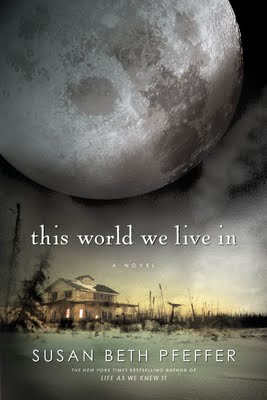
Just Finished…This World We Live In

This World We Live In – Susan Beth Pffefer

(Last Survivors trilogy)

This is the last part of a trilogy, the first of which I read a few years ago. An asteroid strikes the moon and shifts it closer to Earth, causing immense ecological damage. Tsunamis inundate the coasts and volcanoes fill the air with ash. Crops fail and sunlight is a memory. The first part of the trilogy focused on a rural family, the second a brother and sister in New York city, and the third now brings the two together.

It’s a short book, probably only 20,000 words, and it didn’t take me long to read. In places, it was rushed and disjointed, and it felt like there were parts that were cut: Characters would suddenly fly into a rage with no reason, then be calm and reasonable a half page later.

It wasn’t until the last few chapters that I felt the characters were in any peril, and it wasn’t until then that I felt moved or touched by them. There’s a section near the end where I could almost hear the author saying, “That’s it. I’m done. Let someone else write part four.”

Pfeffer’s writing style is clean and tidy enough, although some of the dialogue and arguments felt flat. There are endless descriptions of food, the hunt for food, will the food drop arrive, etc. Fair enough, the main character is starving, but could we have skipped over some of her meals?

Not a bad book, but it felt very much by the numbers. 2/5

Just Finished…Divergent by Veronica Roth (Minor spoilers)


I picked this one up cold from a vibe from Goodreads. Quite a few people seemed to be talking about it and making it book of the month. Having read the 500 pages in under a weekend, I can see why.

The story is set in a crumbling Chicago of the future, some time after an unspecified ‘war’. Society has rebuilt itself along tribal lines: Abnegation, selfless charity workers, Amity, friends to everyone, Candor, who never lie, and Dauntless, the closest to the military. Everyone belongs to one clan, above all other sentiments, even to their family.

When Beatrice Prior is tested to see which clan she should take for the rest of her life, she’s stunned to discover she’s ‘Divergent’, having attributes of more than one clan. Told to hide her test results or her life will be in danger, she chooses the hard and brutal life of a Dauntless, fearless and militaristic. I was expecting her to announce she was Divergent at the start of the book, but it didn’t turn out like that.

The book follows her training and selection, and at times is brutal and honest in its description of the violent life the Dauntless lead, though never to the detriment of the story, or simply for gore. There’s also a romance between Beatrice and her instructor, an understated sub-plot that becomes more important at the end of the book. That was the only part that felt flat for me – there didn’t seem to be much chemistry between them.

The characters are all drawn well, each has their own personalities and weaknesses and strengths. Only the villains Peter and Molly seemed a little cartoonish, but that didn’t stop them from being brutally efficient at removing the competition.

Every page of this book has something going on. Either Beatrice is being tested, is falling in love, is trying to discover what it means to be ‘Divergent’ and why she should hide it, or is trying to stop war breaking out.

There isn’t a space wasted, and the pace of the book doesn’t slow at all. I rocketed through it, stuck to every page.

I can’t wait to swallow up the sequel.

4/5