Just Finished…Cinder by Marissa Meyer

Reviewed by Mel – 4*

Firstly – not an area I usually focus on – but the cover for this is absolutely perfect, with the traditional foot and slipper image of Cinderella, with the lovely text superimposed over the top of the robotic body parts – fantastic!

I really liked the sound of this – futuristic re-telling of Cinderella with the poor servant girl recast as a second-rate citizen cyborg…great idea. And the novel itself is good – I read through it at a pace, liked the characters and thought the ‘robot’ elements were well done. The climatic ballroom scene as well held enough twists to keep it interesting, despite my having guessed (probably like most people) the biggest plots twists that were going to come.

This is probably the first ‘robot’ novel I’ve read since ‘Do Android’s Dream of Electric Sheep?’ – interestingly it covers many similar themes: if people are ‘human’ in all behavioural aspects, have human thought processes and look human, but they just have some cables and wires in there instead of veins, does it actually make them ‘less’ than human? Cinder has a second-rate status due to her being a cyborg (a condition she woke up in after an horrific accident, rather than some random Frankenstein-type experiment).

Overall, interesting ideas and nicely written, a little predictable, but I think it has to be to stick within its roots as a fairytale, so that’s not necessarily a criticism. I’ll definitely be looking out for the next one to see where things go as I think it has scope to be a good series.

The Long Walk – Em’s Review

Being a massive Stephen King fan, the Long Walk, written under the pseudonym of Richard Bachman is a bit of a favourite of mine.

One of the things that really sets the book apart from a lot of King’s work, for me, is the setting. Often in King’s world, as Constant Readers will know, we find ourselves in a situation with normal everyday people, people that we can understand and relate to – our contemporaries if you like – suddenly dropped into an incredible and horrifying situation.

Take books like The Stand, Cell, The Mist and so on. Unlike many dystopian tales, these stories chart the cataclysmic events which lead to the dystopian future, following a normal person who we can understand – essentially one of us – into that future, seeing how they cope with the events and the horrors along the way.

The Long Walk is different in that it starts in this Dystopian future, and only hints at the events which have led us to this. There are hints along the way that this is an alternate history America, and that at some point in the past there has been a military takeover which has resulted in America as a dictatorship.

One of the things that strikes me most about the book is the casual acceptance of violence – by the Walkers themselves, the crowd – even small children. It is seen as entertainment, and life is apparently very cheap. However – this clashes with some of the descriptions in the book – the spectators and the boys themselves are very much of our world – the high school students, the problems, dreams and aspirations, and the experiences that the Walkers discuss. This makes the situation that much harder for us, as the reader to understand. On one level we can completely identify with the characters, but on another we can’t imagine the world in which they live, and what has led them to such a casual acceptance of their own mortality, and that of their fellow Walkers, in the name of entertainment. This is reinforced by the fact that the Walk is a voluntary activity  – these boys have put themselves forward for it, and bypassed opportunities to back out at several stages.

I think this is a really clever way in which King puts the characters on our level whilst also putting up a barrier of understanding between them and us, which throughout the book we seek to break down.

The stories of the different Walkers form the backdrop of the story – punctuated by the violent and sometimes disturbing interludes as one by one the boys receive their ‘ticket’. The slow pace of the book adds to the feeling of creeping fatigue, and in a very real sense, you feel like you are going through this experience with the boys.

Again, we never really find a real motivation for the majority of the Walkers to be there. Most come from stable and loving families, they have various tales of regret or problems in their lives, but nothing that you could imagine would push someone to the extremes that they have chosen.

And so, I started thinking – is the Long Walk an allegory for life itself? And the Walkers, and the way they take their ‘tickets’ symbolic of how people approach their own deaths? Or even of the elements of our personalities, and how they change and distort as we approach the end?  Even the concept…walking down your fellow Walkers until you approach the end alone stripped clean of the various facets of personality until there is just the compulsion to continue – could very well be symbolic of the journey through life, with Ray Garraty, our protagonist, symbolising all of us? Or maybe that’s too deep and meaningful! But I liked it!

Another very interesting thing about the book is the idea of the Long Walk as a televised reality show. In the era of books such as the Hunger Games, and with a proliferation of reality shows such as Big Brother on TV, one may think that this is standard fodder for a fiction writer. But you must remember that the Long Walk was written in the 60’s, one of King’s first books (although published later), so pre-dated reality TV by decades. This makes it all the more interesting, almost prophetic in its themes of real people as consumables for the masses, stripped of voice, personality, humanity.

The crowd is often described almost as an entity in itself – a solid shouting, jeering, undulating mass, single-minded in its uncaring brutality. This adds to the feeling of isolation of the Walkers. Though constantly surrounded by people, it is as if they were the only ones who are real – even the death-dealing soldiers on the half tracks are faceless automatons, part of the rolling scenery of the Walk.

As with much of King’s work, the characters are the crux of the story. Whatever else is happening, whatever horrors await, the characters are so deftly drawn, so real and vital, that they become the focus of the story – everything else becomes secondary to them – their thoughts, feelings and actions. King is a master of character building – his are living breathing characters – not just ‘bags of bones’ that he uses puppet-like to voice his dialogue. That is what makes a story like this so powerful, the realistic strengths and weaknesses of his characters – there are no ‘good guys’ or ‘baddies’ in his story, the good have bad points, the bad good. Just like in real life!

In summary, I think that the Long Walk is a gruelling, often gut wrenching, and sometimes heart breaking read – it makes you think about mortality in a different way – not as something momentous and hallowed, but as a switch that can be flicked at a moments notice by stumbling once too often as you pass along the road.
The Long Walk…Mel’s Review

Although this book is set in a dystopian future America, you learn very little about that world, what it is like and how it came to be that way…interestingly your whole perspective of the world and people in it are viewed through a ‘long walk lens’.


What I liked about this book, which in itself feels like a long and gruelling read at times (in a good way), is that it spends the entire time examining a terrible event in crippling slow motion through the eyes of those experiencing it. Comparisons to novels such as The Hunger Games only exist as far a this being semi- televised competition featuring young people, who must fight – or in this case walk – to the death. Unlike HG, The Long Walk focuses not on the action and bloody deaths, but the excruciating mental experience of the competitors. There is a close examination of human nature and how that can be twisted and tainted by a person’s environment in both negative and positive ways.
Overall, this is a thought-provoking read, that relies on subtle indicators to a world corrupt and terrible that would champion such a brutal event as the long walk, rather than overt themes and actions. It left me rather emotionally numb – just as the boys surrounded by death seemed to become – with an odd sense that somewhere out there Garraty and the others are still walking on this endless road: some ghosts, some living dead and others so mad they might be anything….what kind of world is that? I have to say I’m really not sure.

Just Finished…Starcrossed by Josephine Angelini

I bought this ages ago on a recommendation and kind of forgot about it, so I started it last week without reading the blurb.

This is the first ‘mythology’ based YA I’ve read – not sure if there’s loads of them around or not – and it was great. I loved the detail of the writing – the slow development of the character relationships; the dynamics added by the recycling of mythological characters and stories. It is good enough to keep you guessing what the mysteries are and how they will unfold.

I think what I liked best about this was the depth of the world-building: the reflection of well-known myths and lesser known classic themes is woven so well into the world of the Scions and I think gave a wonderfully deep texture to the world the story is told in. Helen and Lucas are a lovely pairing – I felt they were quite realistic in their relationship – with all the obvious difficulties – I’ve definitely got a soft spot for Lucas and Hector (but then I always loved Hector in the Illiad).

Overall – really liked this: it’s intelligently written and works the mythology angles perfectly without being contrived or superficial. Can’t wait for the next book – if I could have got it at 2.00am this morning I probably would have – so that tells me how much I enjoyed this! 🙂

Rating: 5*

—————————-

Blurb:

When shy, awkward Helen Hamilton sees Lucas Delos for the first time she thinks two things: the first, that he is the most ridiculously beautiful boy she has seen in her life; the second, that she wants to kill him with her bare hands. With an ancient curse making them loathe one another, Lucas and Helen have to keep their distance. But sometimes love is stronger than hate, and not even the gods themselves can prevent what will happen…

———————————

Just Finished…Blue Sky Days by Marie Landry

With my YA reads this year, aside from The Hunger Games I’ve been trying genres that I don’t normally read and as far as possible – indie debut authors. One of the things I like best about the good indie authors I’ve read is that the freedom of publishers and others shaping the book means that the story is exactly what the author wanted to tell and in the way they wanted it. If you look at an author as an artist, then this freedom is a good thing.

So…Blue Sky Days…this is a contemporary romance in the main, a genre I don’t often read and so in some ways this was a refreshing change. In many YAs I read, the romance is something that comes along with action and angst and great danger. This book is almost a complete inversion of that model – the ‘action’ and ‘danger’ have significance and grow out of the romantic theme.

I’ll not be giving anything away – as the blurb tells you – that after a beautiful initial romance, Nicholas becomes ill – so you can hopefully see what I mean about where the ‘danger’ comes from. In many ways it was good to read a book about real danger…the things that threaten people’s lives every single day, the hardship that people have to endure through serious and terminal illness and how that impacts the relationships they have with those around them.

I’d read several reviews prior to reading Blue Sky Days and knew that many readers had found this an emotional book to read – unsurprising given the subject matter – and I certainly found it thought-provoking for the same reasons, not necessarily identifying completely with Emma and her experiences, but her responses and perspective made me consider things in my own life that perhaps you don’t take the time to focus on enough in daily life. Every moment for Emma and Nicholas becomes precious and special, placed under a microscope because of their situation, and their relationships with friends and family are very affectionate and open – despite their difficulties, it is a world many people would want to live in.

Emma’s narration is very interesting – it is so personal and open emotionally, that I felt like I were reading her thoughts in a diary. In this way it is unlike other YA books I’ve read – the depth of her self-reflection and knowledge were much greater than others I’ve read, however, this may be more typical of romance genre (and I wouldn’t know!) 🙂 In turn, all of the characters close to Emma are very similar – very emotionally open and articulate their feelings regularly through unguarded dialogue or affectionate gestures. Some readers might find that openness unusual – but as Emma regularly notes, she finds it hard to believe herself, given her past experience with her mother – and for the style of book, it all works together well. Right from the start of the book Emma is on a journey, transitioning from a life of eduction and boundaries to a new world of independence and she draws you into this as though you are absolutely a part of her life, just as Nicholas, Daisy and the other characters do for her.

‘Blue Sky Days’ themselves – as you discover in the story – are these wonderful moments of time and clarity, when you look at the world around you and see what is truly important: the people you care about, the beauty in the world around you and the things that change your life.

Blue Sky Days feels like a very personal book. The characters, situation and emotional intensity feel as though they come from real experiences and perhaps this is the case. I rarely read author’s acknowledgements in books, but for this I did and feel that there is a real and important connection between the author and this story, more than most. And this brings me back to the beauty of indie authors – this is Marie Landry’s and Emma’s story, told exactly as it should have been.

Overall a lovely book, to be read with the knowledge that you’re delving completely into someone’s life and – just as I read in another review – Blue Sky Days will make you feel.

Rating: 4*

—————————-

Blurb: A year after graduating from high school, nineteen-year-old Emma Ward feels lost. She has spent most of her life trying to please her frigid, miserable mother – studying hard, getting good grades, avoiding the whole teenage rebellion thing – and now she feels she has no identity beyond that. Because she spent so many years working hard and planning every moment of her life, she doesn’t have any friends, has never had a boyfriend, and basically doesn’t know who she is or what she really wants from life. Working two part-time jobs to save money for college hasn’t helped her make decisions about her future, so she decides it’s time for a change. She leaves home to live with her free-spirited, slightly eccentric Aunt Daisy in a small town that makes Emma feel like she’s stepped back in time.

When Emma meets Nicholas Shaw, everything changes – he’s unlike anyone she’s ever met before, the kind of man she didn’t even know existed in the 21st century. Carefree and spirited like Daisy, Nicholas teaches Emma to appreciate life, the beauty around her, and to just let go and live. Between Daisy and Nicholas, Emma feels like she belongs somewhere for the first time in her life, and realizes that you don’t always need a plan – sometimes life steers you where you’re meant to be.

Life is wonderful, an endless string of blue sky days, until Nicholas is diagnosed with cancer, and life changes once again for Emma in ways she never thought possible. Now it’s time for her to help Nicholas the way he’s helped her. Emma will have to use her new-found strength, and discover along the way if love really is enough to get you through.

———————————

This review was also posted at Confessions of a Bookaholic blog.

30 Days of Hunger Games…Our own Capitol

So…when The Hunger Games was our Book of the Month in January, one of our regular contributors, Em, didn’t get chance to post her review before the end of the month and so now – as part of 30 Days of Hunger Games – her thoughts finally make it to the blog…

————————————————————-

Like many of you, I didn’t just read the Hunger Games trilogy, I devoured it! When I had to put the books down to do mundane things such as going to work or sleeping, I was left wondering what would happen next, how would it all turn out, who would Katniss choose and so on and so on.

Then, when the final page had been turned I was left with that satisfied but sad feeling I often have when I’ve finished a set of books that I love, knowing that there isn’t another one to look forward to….until I remember that the film is coming out shortly, so that should appease me for a while!

However, unexpectedly, I was also left with a new set of questions.

Not ‘what next’, and ‘how will it end’, but some rather broader questions, the most worrying of which was this;

In the Hunger Games world……who are we?

Of course, we all want to be Katniss, Gale, Peeta, Finnick (Oh – I loved Finnick!)….the heroes of the piece, the protagonists, the ones we have followed, cheered for, cried with, grieved for and celebrated with throughout the books. But the Hunger Games, like so many other modern books, whether intentionally or otherwise, poses much greater moral and social questions than we may realise at first glance.

As was no doubt the intention, I was repulsed and amused by the people of the Capitol – their selfish shallow attitudes, their materialistic focus, their utter indifference to the suffering of the people in the districts who fed, clothed, served and provided for them, so long as their needs were met. And yet, on closer reflection, how are we as a society so different? In the ‘developed’ world, we take a lot for granted – that there will be food on the shelves, petrol for our cars, products in our shops – we live in a world of plenty….and how much thought do we give to where these things come from? For many years we have exploited the workers of less developed countries and societies in order to keep up our supply of things we don’t need, and luxuries that most of them could never hope to have.

Obviously we as a society haven’t a Hunger Games to convict us as the repellent creatures we see in the novels – that kind of voyeuristic bloodlust is thankfully not tolerated in our society…at least to that extent! But how many of us see the warring, the starving, the struggling on the television, and turn a negligent eye to it….as long as we are ok, it seems very far removed.

Whilst we all want to aspire to and empathise with the heroes of the piece, how many of us felt any empathy for the people of the Capitol? Very few I would expect, and rightly so – their portrayal as weak, petty, frivolous beings doesn’t inspire empathy….but maybe, just maybe, it should inspire a little self- reflection, and the need to be a little more aware of what is going on outside the walls of our own ‘Capitol’.

Book of the Month – March – The Bachman Books

Em’s choice this month – we’ve all read some Stephen King along the way – Em LOVES him I think 🙂 and so it’s no surprise she’s nominated one of his for BotM. I’m really looking forward to reading these short stories as I’ve not done any Stephen King for a while. As we’re doing The Running Man and The Long Walk, we’ll be on these for March and April to give everyone chance to read both.

As usual – feel free to join us in a read along – if you want a guest review just send it over or get in touch with comments 🙂

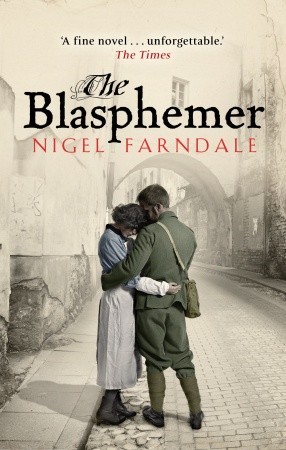
The Blasphemer…Vic’s Review

The Blasphemer looks at several generations of males in one family, their lives, their loves and how they express them. The book flips backwards and forwards between each character, gradually unfolding a period of emotional upheaval in each of their lives. Usually books written in this way drive me daft, I’m just getting into one character’s story when the narrative breaks off and takes me somewhere else, leaving me frustrated but The Blasphemer made it easy to get into each and every life story, partially because it’s so descriptive that you can easily visualise the situations it’s describing and partly because the characters draw you in until you really want to know what will happen to them next.

Underlying the stories are a few interesting themes, can you really love someone if your instinct isn’t to put their life above your own? If you betray someone, will there be a price to pay and can it be made right? What constitutes cowardice? Are there angels out there? Daniel’s flaws, the fact that his instinct kicks in and he pushes the woman he loves out of the way in a blind panic to escape a plane crash, makes him somehow a much more likeable main character than many in literature. He isn’t perfect and he’s done something terrible but something we couldn’t guarantee we wouldn’t do ourselves. Too many men in books are the traditional male rescuer, putting life and limb in peril without a thought to save a woman. Daniel doesn’t do this automatically but he does try and make it right. Can he? Will she forgive him for letting instinct over-ride love? Well that would be telling. Is his grandfather a coward for leaving the battlefields of the Somme? You’ll have to make your own mind up on that one. For me, the book underlined that you can’t really judge a man’s actions until you’ve been in his circumstances yourself and you know for certain how you’d react. We idealise behaviours that perhaps aren’t realistic and expect too much of a person under extreme stress. The book is written with a really neutral tone, the author is explaining the facts and leaving you to make your own value judgements on the characters and I liked this, the lack of trying to direct the reader’s thoughts along a certain path.

The one thing that didn’t really grab me in this book was the theological discussions between Daniel and his friend. I’m not wildly into religious philosophy and for me, these debates were a bit lengthy and a bit ‘A-level seminar discussion’ but that’s a personal thing and if spirituality and theology have even the slightest pull for you, you might well enjoy them.

All in all I found this a really interesting read, with unusual characters, all of them flawed somehow and all stumbling along trying to find the right path and make good damage that they’ve done somehow unwittingly inflicted. Definitely recommended

Just Finished…Forgotten Self by Rachel Carr

Oh yes – it gets 5* 🙂 


Forgotten Self is a really good read. Although I’ve not read a huge amount of books in the YA Angel/Demon field – Hush Hush series, Katherine Pine’s After Eden (good) and a couple more I won’t mention as they were shockingly poor – I quite like them when they’re done well. Forgotten Self is done very well and of those I’ve read I would rate it as the best.

The story is a good length and I read it in a couple of days in two long-ish sittings. Even though it’s not a long book it is well-detailed; the ‘angelic’ world has a good depth to it, the explanations for which are delivered nicely throughout the book alongside Abby’s ‘real’ life. The characters are very well drawn, especially Abby, whose POV we read from. And although I tend to plump for one guy or another in a book, I found both Jonathan and Lucas appealing – there are some nice, subtle dynamics for romantics to enjoy without it being a straight ‘love triangle’.

In the first couple of chapters I was enjoying the scene setting with Abby’s life, school friends and her relationship with cousin Kelly. I thought the descriptions of spiritual experiences and Abby’s grief were captivating – then BAM! Chapter 3 hits and there’s a very curious car accident and you were sucked into a bigger mystery with Abby. From that point on I struggled to put the book down as the pace was kept up in a perfect rhythm of events and mystery solving.

I think to compare with something like Hush Hush, Forgotten Self is more sophisticated – although I like Hush Hush there are some things – like not being able to stay away from the good-looking but dangerous seeming boy that felt a little cliché. The delivery of the narrative in this is simply better. Abby’s character feels more genuine and likeable than Nora’s: she nicely sarcastic, reasonably pragmatic, but also real has teenager ‘moments’.

This book is really well-written, from description to dialogue and emotions there is little repetition of images (something I found has irritated me in some other YA books) and they are quite original whilst being easy to read.

For anyone thinking of trying a YA Angel book – forget about the New York Times Bestselling series, this is the first I’d be recommending to them J

The Blasphemer…Bonnie’s Review

The Blasphemer is an interesting novel that weaves together the stories of several men from different generations of the same family. As you might expect this is a well-constructed novel, with clearly drawn characters and interesting narrative style delivered through the switches from one time period (and life) to another.

The author employs beautiful imagery in his detailed descriptions, which really build depth into the world surrounding each of the men. However, as interesting as I found the book I did not engage with all of the characters – despite them each going through a life-altering experience during your time with them, which pulled you into their lives in an absolute and intrinsically personal way.

What I enjoyed most about The Blasphemer was the questions it raised and asked me to consider. The last line of the book blurb asks “How will any of us behave when we are pushed to extremes?” and this was definitely the focus of my interest in the novel. Perhaps because I write myself I have some bias towards examining human behaviour – wondering how people behave and why in given situations, so that I can write characters of my own. What is done well in the book is neutrality – the experiences, actions and emotional responses of each character are delivered without judgement, although you the reader are free to add whatever you wish…as the blurb points out, when (one of the main characters, Daniel) pushes his wife out of the way so that he can escape a plane crash, we judge him for this reflex, natural survivalist action.

The Blasphemer dissects the characters and their relationships – it makes you question whether you can be truly loved by someone, if they do not – in the most dire of circumstances – put your life before theirs. It also examines the different types of relationship that exist between friends, lovers and families. It is interesting and thought-provoking and definitely worth a look.